International
 Brasil
  Chile
Chile  Deutschland
  España
  France
  Italia
  Panamá
  Portugal
  Russia
  UK
UK 


Identify if there is a risk of passing on a genetic disease to your children
Genetic Carrier Screening Tests, also known today as Carrier Screening Tests, are recommended for everyone — even those with no known family history of genetic conditions.
The CARRIER Expanded test uses advanced DNA sequencing to analyze hundreds of genes and detect variants associated with inherited diseases, helping to identify couples at risk of passing them on to their children.
These are genetic tests that detect alterations that can be silently passed from parents to children. Even healthy individuals with no family history may carry genetic variants that could cause disease in their offspring.
There are two main types of diseases inherited in this way:
Autosomal recessive conditions: The risk arises when both partners carry the same alteration, resulting in a 25% chance that the child will inherit the disease.
X-linked conditions: Women can be asymptomatic carriers but may pass the disease to their children.
These tests analyze numerous autosomal recessive and X-linked genes, helping identify carriers and prevent the transmission of genetic diseases in a reproductive context.
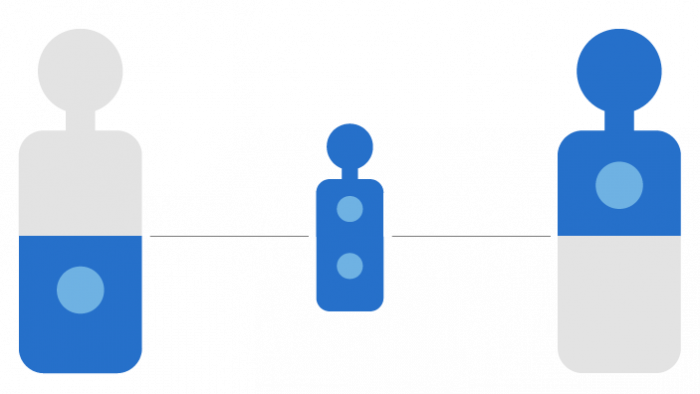

It is estimated that 1 in 2 people is a carrier of a serious genetic condition, even if they show no symptoms or have no family history. Around 2% of couples (1 in 50) are at risk of having a child affected by an autosomal recessive or X-linked disorder, meaning 1 in 200 newborns may be impacted. In more than 80% of diagnosed cases, there was no known family history.
The CARRIER Expanded test covers 97% of the risk associated with these types of conditions, reducing reproductive risk from 1 in 200 to approximately 1 in 7,000.
The CARRIER test is recommended for:
Analysis of 294 autosomal recessive and X-linked genes.

High-precision sequencing with average coverage above 99%.

Gene selection based on scientific research.

Flexible and compatible with your partner’s or donor’s results.

| Conditions detected by CARRIER | Carrier Frequency in General Population |
|---|---|
| Alpha Thalassemia | 1 in 25 |
| Cystic Fibrosis | 1 in 25 |
| Spinal Muscular Atrophy | 1 in 45 |
| Beta Thalassemia | 1 in 50 |
| Hemoglobinopathies | 1 in 50 |
| Non-syndromic Sensorineural Hearing Loss Type 1A | 1 in 50 |
| Congenital Adrenal Hyperplasia | 1 in 55 |
| Phenylketonuria | 1 in 58 |
| Autosomal Recessive Polycystic Kidney Disease | 1 in 70 |
| Fragile X Syndrome | 1 in 250 |
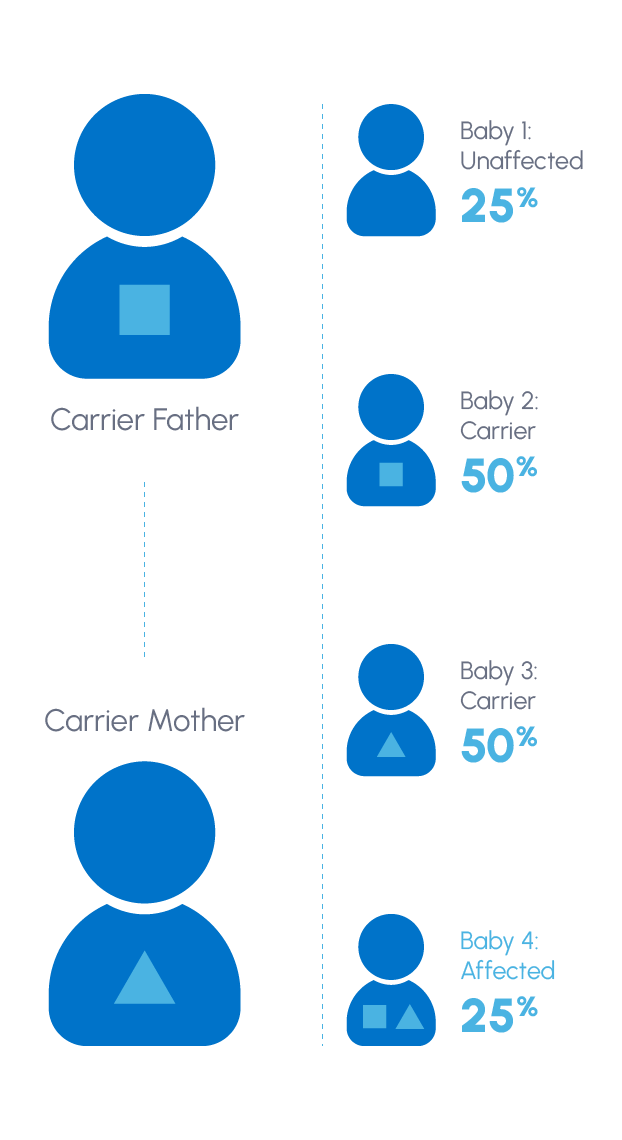
If both partners are carriers of the same hereditary condition, there is a 25% risk that their child will be affected. In this case, a genetic counselor will provide personalized guidance to explore options, such as undergoing IVF with Preimplantation Genetic Testing for Monogenic Disorders (PGT-M).
This allows selection of embryos free of the disease before transfer to the uterus—an option available for most inherited disorders.
Gamete donation
Couples may choose gamete donation to select a donor who has undergone carrier screening and does not carry a mutation in the same gene as either partner.
What does it mean if we’re both carriers of the same mutation?
Anyone can be a healthy carrier without showing any symptoms. Being a carrier means one of the two copies of a specific gene has a mutation. Because the other copy is normal, the gene still works and the individual is unaffected.
The issue arises when both partners carry a mutation in the same gene, since there’s a 25% chance with each pregnancy that the child will inherit both altered copies and be affected.
In such cases, a genetic test can be performed on embryos—Preimplantation Genetic Testing for Aneuploidies (PGT-A)—to determine which embryos are unaffected and eligible for transfer.
More than 80% of children with genetic disorders are born to parents with no known family history or symptoms of such disorders.
When a mutation is detected in the same gene for both members of a couple, there is an increased risk of them having a child affected by a genetic disorder.
In such cases, the options for conceiving a child who is not affected by the inherited disease include:
In vitro fertilisation treatment with Pre-implantation Genetic Testing for Monogenic disorders (PGT-M).
For the majority of inherited conditions, Juno Genetics can offer tests that reveal which embryos have inherited mutations from the parents. Only embryos predicted to be unaffected are transferred to the mother’s uterus.
Gamete donation
Couples can consider gamete donation from a donor who does not carry a mutation in the same gene as the male or female partner.
Genetic tests, such as the CARRIER Expanded test, analyze your genes—your body’s instruction manual. These tests detect variations or mutations that may affect how your genes function and could cause disease. They can help assess the risk of passing a hereditary disorder to your children or determine the cause of a known genetic condition in the family.
It has been estimated that everyone carriers 3‐5 genetic mutations but in most cases these do not cause a disease. This is because we each have two copies of every gene (with the exception of genes on the X-chromosome in men). The GeneSeeker test looks at variations in the DNA which are ‘recessive’, meaning that they only cause a disease when both copies of the gene have a mutation. If you have a recessive mutation in one copy of a gene, stopping it from working properly, the other (normal) copy is sufficient to prevent the disease. However, if your partner carries a mutation in the same gene, then there is a risk that a future child could receive a defective copy from each of you, leaving them with no functioning copies of the gene, and causing them to develop an inherited disorder.
Everyone carries 3 to 5 genetic mutations, which usually don’t cause disease because we have two copies of each gene. The CARRIER Expanded test identifies recessive mutations, which only cause disease if both copies of the gene are altered.
If both you and your partner carry a mutation in the same gene, your child may be at risk of inheriting the disease.
Most people who carry recessive mutations have no family history of inherited conditions. These disorders can remain hidden for generations and suddenly reappear.
Everyone is a carrier of recessive mutations, but we don’t realize it because we have two copies of every gene (except for X-linked genes in men). Having one altered copy isn’t enough to cause a disorder. For a recessive condition to manifest, both gene copies must be affected.
The CARRIER Expanded test can detect hidden mutations you and your partner—or your donor—may carry and determine whether you both carry mutations in the same gene. In such cases, there’s a risk that your child could inherit both defective copies and develop a genetic condition.
Whether you plan to conceive naturally or through assisted reproduction (e.g., IVF), the CARRIER Expanded test can help identify whether you or your partner are at increased risk of conceiving a child affected by a genetic disorder.
Several scientific societies in Spain recommend genetic carrier screening for all women planning a pregnancy.
If the results show that you and your partner both carry mutations in the same gene, there is reproductive risk. Once this risk is identified, strategies are available to prevent pregnancy or birth of a child with the disorder—such as preimplantation or prenatal genetic testing or using donor gametes.
Yes. Since we all carry recessive mutations, it’s likely your child will too. If you carry an altered gene, your child has a 1 in 2 chance of inheriting that copy and being a healthy carrier.
Being a carrier does not mean your child will develop the disease, as the other gene copy still functions and prevents the disorder.
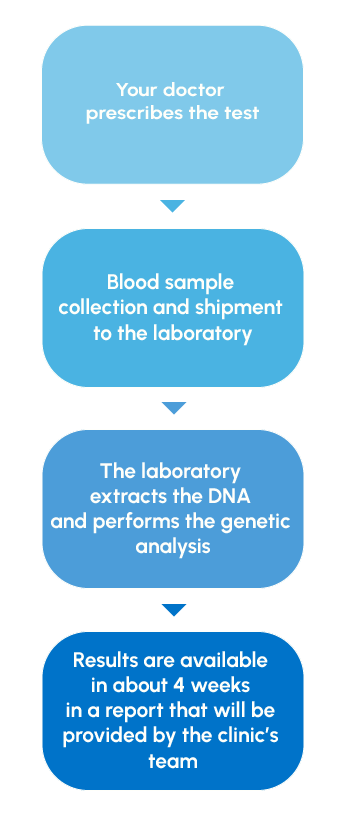
CARRIER Expanded test results are typically available within 4 weeks after Juno Genetics receives the blood sample.
In most cases, no. The CARRIER Expanded test detects recessive mutations, which only cause disease if both copies of the gene are affected. If only one copy has a mutation, the other functions normally and prevents disease.
If a potentially significant variant for your health is detected, IVI’s genetic counseling team will provide you with all the necessary information.