International
 Brasil
  Chile
Chile  Deutschland
  España
  France
  Italia
  Panamá
  Portugal
  Russia
  UK
UK 

For women aged 35 to 40, time is a crucial factor because, with age, the chances of becoming a mother using one’s own eggs decrease. That is why we want to introduce IVF Genetic, an innovative combination of advanced and clinically validated techniques designed to significantly increase the likelihood of pregnancy per transfer. This method reduces the time required as well as the emotional and financial costs.
The IVF Genetic treatment combines in vitro fertilization (IVF) with preimplantation genetic testing to detect potential chromosomal abnormalities or aneuploidies in embryos (PGT-A). Thanks to this analysis and the detection of chromosomal issues in the embryo to be transferred, the risk of miscarriage is reduced, while the chances of having a healthy baby—free from conditions such as Down syndrome, Turner syndrome, or Klinefelter syndrome—increase.
Given the growing concern among our patients to ensure the highest level of safety in their fertility treatment, IVI offers IVF Genetic, which combines both techniques under highly favorable conditions.


We recommend in vitro fertilization combined with PGT-A for:

This test is the most advanced tool for embryo selection.
IVI uses the most innovative technology for this purpose. PGT[A]Seq is the only technique clinically validated by independent studies, allowing patients to obtain a higher number of viable embryos compared to other techniques available on the market.




Preimplantation genetic testing allows us to detect potential chromosomal abnormalities (PGT-SR), issues at the gene number level (PGT-A), or a specific gene mutation (PGT-M). Thanks to these analyses, we are able to identify genetic problems in embryos and transfer only those that are optimal, thereby reducing the risk of miscarriage and increasing the likelihood of giving birth to a healthy baby.
|
** Pregnancy rate after three cycles. Each cycle includes the first embryo transfer as well as subsequent transfers of all embryos generated and cryopreserved during that cycle. |

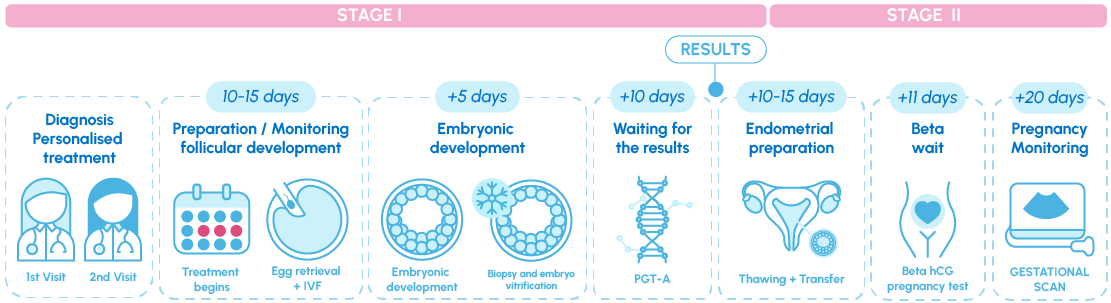
At IVI, treatment begins from the very first consultation with one of our fertility specialists, at the clinic of your choice, through an analysis of your medical records and any information regarding previous reproductive treatments, whether they took place in Spain or another country. A comprehensive gynecological examination and a semen analysis are also performed in the case of heterosexual couples. We are convinced that a complete and personalized medical diagnosis is key to helping our patients achieve the goal that drives us: having a baby.

For 12 to 15 days, the patient self-administers daily injections at home to stimulate the ovaries and encourage the development of not just one, but multiple eggs during the current cycle. This makes it possible to obtain a larger number of embryos without having to repeat the process. A trusted gynecologist monitors the number of follicles (the cavities where each egg develops) through several ultrasounds (usually 3 to 4) and a blood test. When the follicles reach the appropriate size and stage of development, a dose of HCG hormone is administered to trigger ovulation, and the egg retrieval is scheduled at the chosen IVI clinic 36 hours later.

Egg retrieval is a minor procedure performed in the operating room under sedation to collect mature eggs. Using an ultrasound probe, the doctor accesses the eggs through the vaginal cavity; each follicle is gently punctured, and the fluid containing the eggs is collected. The procedure usually takes 15 to 20 minutes, after which the doctor informs the patient of the number of eggs retrieved. Patients can go home the same day and return to their normal activities.

Once the eggs and sperm sample (from the partner or a donor) are available, in vitro fertilization is performed using the ICSI technique. This involves injecting a single sperm from the collected sample directly into each egg

During embryo culture, our IVF laboratory specialists monitor the embryos until the fifth or sixth day of development, when they reach the blastocyst stage, and classify them according to their quality.

Embryos that meet the required quality are biopsied, meaning a very small opening is made to extract a few cells. The embryos are then vitrified (cryopreserved) while awaiting the results of the genetic analysis. The biopsied cells undergo PGT-A, the preimplantation genetic testing that confirms whether the embryo has the correct number of chromosomes. This test is performed using next-generation sequencing (NGS) technology, which can detect potential abnormalities in any of the 23 pairs of chromosomes. Ten days later, the analysis results are available. Based on the number of chromosomes detected, it is possible to confirm whether the embryo is normal and, if so, to thaw it for transfer into the maternal uterus.

Before the embryo transfer, the patient’s uterus is prepared to ensure that the endometrium (the inner lining of the uterus) has the appropriate thickness to receive the embryo and support pregnancy. On the scheduled transfer day, the embryologists thaw one of the embryos that has been diagnosed as healthy. The transfer takes place at the chosen IVI clinic and involves placing the best embryo into the maternal uterus via the vaginal route using a transfer catheter. The procedure is completely painless and does not require any anesthesia. After a few minutes of rest, the patient can resume her normal activities and go home.

The gynecologist will specify the day for the pregnancy test, which is usually performed via a blood sample 11 days after the transfer. If the test is positive, after a follow-up ultrasound— which can be done by your regular gynecologist—IVI will inform you 20 days later that your procedure is officially complete.



The approximate cost of the main fertility treatments at IVI varies depending on the specific needs of each patient. Additionally, the quotes for assisted reproductive treatments may differ depending on which services are included in the treatment.
It is important to note that the cost can vary according to the individual case, the tests required, and the progress of the treatment. In general, the patient’s medication costs are not included in the initial estimate.
Each type of PGT is specific, but they all require undergoing an in vitro fertilization cycle in order to analyze the genetics of the resulting embryos. The eggs are retrieved (follicular puncture) 13 to 15 days after ovarian stimulation. After being fertilized with either donor sperm or the partner’s sperm, as applicable, the embryos are cultured until they reach the blastocyst stage, on the 5th or 6th day after retrieval. At this point, an embryo biopsy is performed, and the embryos are frozen while awaiting the genetic results, which are usually available within 10 to 15 days. In a subsequent cycle, after preparing the endometrium, embryos with a normal chromosomal profile will be transferred.
IVI, a leading center in reproductive medicine, offers the best assisted reproduction techniques and treatments in Spain. A multidisciplinary team will support you throughout the entire process at our clinics with English-speaking staff.