 International
 Brasil
  Chile
Chile  Deutschland
  España
  France
  Italia
  Panamá
  Portugal
  Russia
  UK
UK 
Cervical mucus is one of the most reliable and natural indicators for identifying fertile days within the menstrual cycle. Through changes in texture, color, and quantity, the body provides clear signals about ovulation, fertility, and even possible early signs of pregnancy. Understanding how it changes before, during, and after ovulation not only helps improve the chances of conception but also provides valuable insight into hormonal and reproductive health.
In this article, Dr. Federico Merino, director of IVI Málaga, takes an in-depth look at the relationship between cervical mucus and fertility, how to recognize cervical mucus when fertile, what happens after ovulation, how to interpret it using a chart, and the typical characteristics in early pregnancy. This comprehensive guide is designed to clearly and directly explain how to analyze cervical mucus to identify your most fertile days.
How does cervical mucus affect fertility?
Cervical mucus is a secretion produced by the cervix whose main function is to either facilitate or hinder the passage of sperm into the uterus, depending on the phase of the cycle. The relationship between this and fertility is therefore direct and biologically essential.
During fertile days, mucus changes to create an optimal environment for sperm survival and mobility. At this time, it may show the following distinctive features:
- More abundant
- Stretchy, elastic texture
- Transparent or slightly whitish
- Similar to raw egg whites
This type of mucus can keep sperm alive for up to five days, extending the fertile window. By contrast, outside the fertile period, it’s usually thick or absent, acting as a natural barrier.
Understanding how cervical mucus responds to hormonal changes—especially estrogen—is key to identifying when the body is at its peak fertility.
What does it look like when you are fertile?
Identifying cervical mucus when fertile is one of the most effective ways to detect ovulation without the need for hormonal tests. Just before and during ovulation, rising estrogen levels cause very specific changes in cervical mucus.
The clearest signs of fertile days include:
- A constant sensation of vaginal wetness
- Abundant, slippery, elastic mucus
- The ability to stretch several centimeters between the fingers
- An appearance similar to egg whites
This characteristics indicate that the body is ready for conception. The last day this mucus is observed usually coincides with ovulation or occurs just before it, marking the most fertile moment of the cycle.
Tracking these changes daily helps identify personal patterns, which is especially useful for women with irregular cycles.
How can you track cervical mucus changes during your cycle?
A cervical mucus chart is a visual tool that allows you to record daily changes throughout the menstrual cycle. It is commonly used in fertility awareness methods and natural family planning.
This chart typically includes:
- Cycle day
- Vaginal sensation (dry, moist, wet)
- Mucus appearance (sticky, creamy, stretchy)
- Color and quantity
Over time, this record helps more accurately identify:
- The fertile window
- The probable day of ovulation
- Unusual hormonal changes
In addition, the chart can help detect issues such as infections, hormonal imbalances, or anovulatory cycles. For those trying to conceive, this chart becomes a strategic guide for timing intercourse on the days with the highest probability of conception.
Find here the different types of discharges, according to the moment of the cycle:
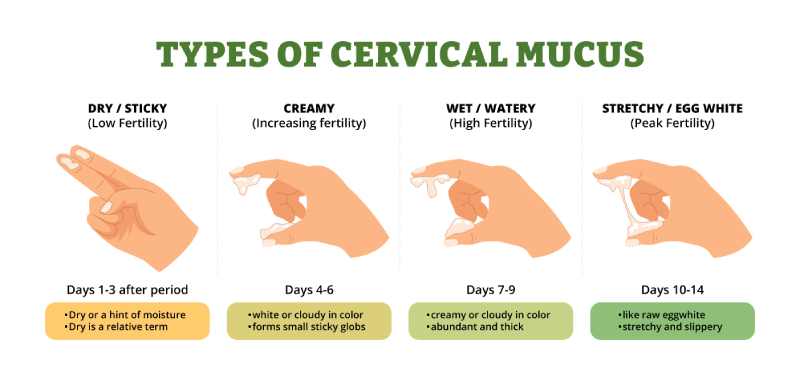
How does it change after ovulation?
Once ovulation has occurred, the mucus changes clearly. After the oocyte is released, progesterone becomes the dominant hormone, making mucus less favorable for sperm.
After ovulation, it is common to notice:
- A marked decrease in mucus
- A thicker or stickier texture
- A drier vaginal sensation
- An opaque white color or no discharge
This change indicates that the fertile window has closed. Cervical mucus now acts as a protective barrier for the uterus, reducing the risk of infection and preventing further conception in that cycle.
Recognizing this pattern is important both for those trying to conceive and for those who wish to avoid pregnancy naturally.
How to detect early pregnancy by observing changes
Cervical mucus may show subtle changes that, in some cases, can be confused with premenstrual symptoms. However, after implantation, some women notice differences. In early pregnancy, cervical mucus may:
- Increase slightly in amount
- Be white, milky, or creamy
- Not disappear after ovulation
- Maintain a constant sensation of moisture
This mucus is associated with sustained progesterone levels and the formation of the mucus plug, which helps protect the developing pregnancy. Although this signs alone do not confirm pregnancy, its persistence after ovulation can be an early sign to consider alongside other symptoms.
Conclusion: key points about cervical mucus
- It’s a natural and reliable indicator of female fertility
- Observing it helps identify the fertile window without testing
- Egg-white–type mucus signals the days with the highest chance of pregnancy
- A chart helps detect patterns and anticipate ovulation
- After ovulation cervical mucus confirms the end of the fertile period
- It may show subtle changes after implantation and be an indicator of early pregnancy
- Learning to interpret it improves understanding of the cycle and hormonal health
Understanding and tracking cervical mucus changes empowers women to make informed decisions about fertility, family planning, and reproductive health in a natural, body-based way.





Comments are closed here.